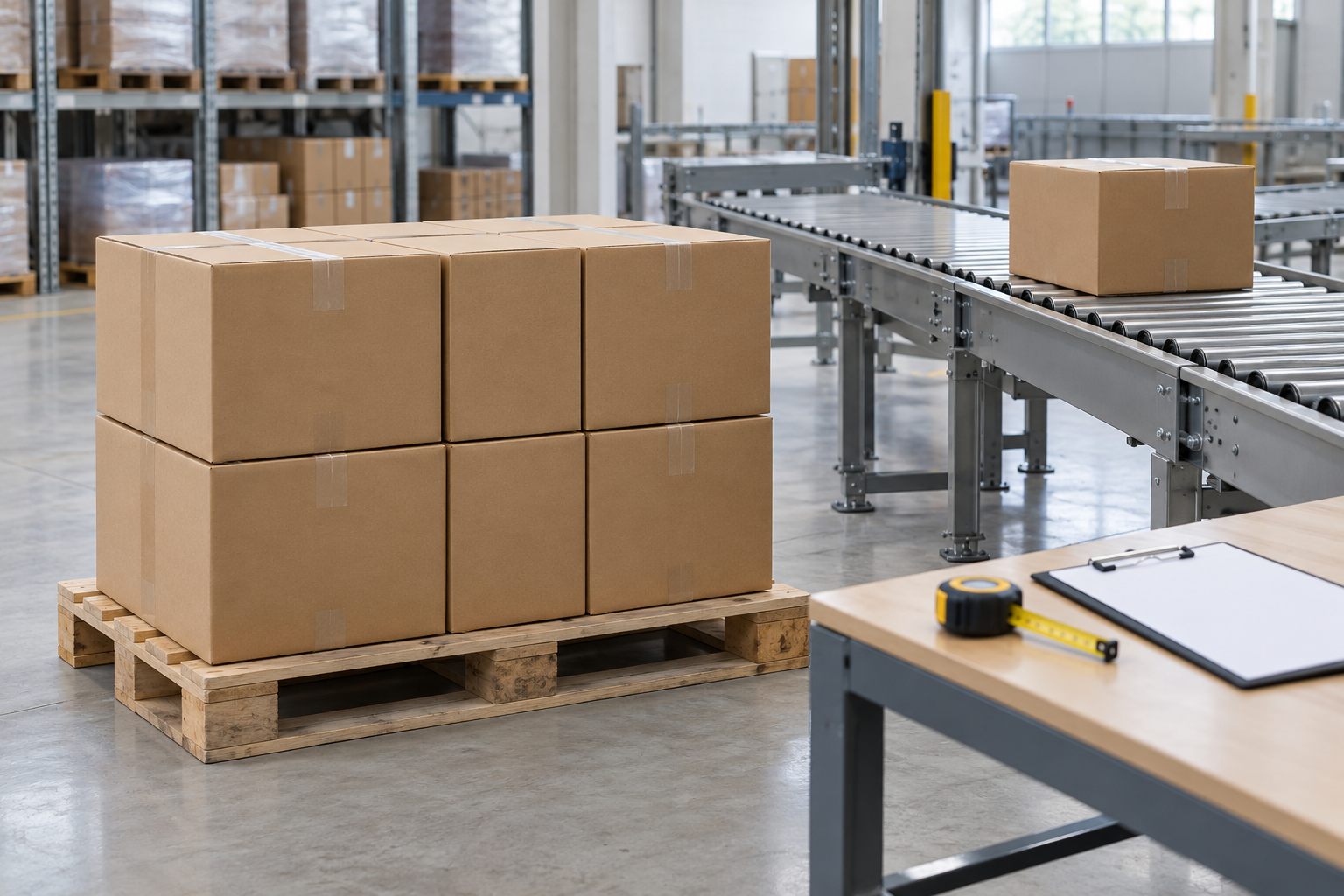
Use this cobot palletizing checklist to prepare a clear project brief for a factory in Malaysia. Before comparing systems, record package details, pallet patterns, required output and the way products enter and leave the working area.
A useful brief describes the complete handling task, not just the robot. It helps the engineering team discuss equipment selection, layout, integration and the information still needed before a proposal.
1. Describe Every Package You Plan to Handle
List the length, width, height and weight range of each carton or package. Include the smallest, largest, lightest and heaviest items. Explain whether dimensions or weights change between product batches.
Provide photos and sample packages where practical. Note packaging material, taped surfaces, product orientation and any handling restrictions. Do not assume different products can use the same gripping arrangement without assessment.
2. Define the Pallet and Stacking Pattern
Record pallet dimensions and the required completed stack height. Show the desired arrangement for each layer, including orientation changes. Explain whether the line uses one pattern or several product-specific patterns.
Identify any requirements for slip sheets, labels or downstream wrapping. The project brief should also explain how completed pallets will be moved and whether the proposed stack needs further assessment for transport and handling.
3. Measure the Real Production Flow
State the required packages per minute and operating hours. Distinguish normal output from short peaks. Describe whether cartons arrive evenly, in groups or after an upstream machine stops and restarts.
Include the time and space needed to replace an empty pallet and remove a completed one. A throughput discussion should cover these transitions as well as the stacking motion.
4. Plan the Infeed and Pallet Movement
Prepare a layout showing the package arrival point, conveyor height, pallet positions and nearby equipment. Mark operator routes, access doors and available maintenance space.
Consider the complete route from packaging to pallet dispatch. Review belt conveyor transfer options where products need a supported carrying surface. For changing handling routes, discuss whether flexible conveyors suit the product and working arrangement.
5. Clarify Integration and Project Responsibilities
Describe the existing equipment and available control interfaces. Ask who will handle electrical connections, machine signals, installation, testing and handover. Identify site restrictions and the intended installation period.
A collaborative robot does not by itself establish that an entire palletizing application is safe. Ask the system integrator how application risks, access and required protective measures will be assessed before operation.
Cobot Palletizing Checklist for Your First Enquiry
- Package dimensions, weight ranges, photos and samples
- Pallet size, layer patterns and completed stack height
- Normal and peak output, plus operating schedule
- Infeed location, transfer height and existing equipment
- Empty and completed pallet movement
- Available space, operator access and site restrictions
- Control interfaces, responsibilities and project timing
Discuss Your Palletizing Brief With Chin Wan
Use this checklist as a starting point, then review your actual application with Chin Wan Engineering Sdn Bhd. Explore our cobot palletizer solutions in Malaysia or send your palletizing project requirements.